

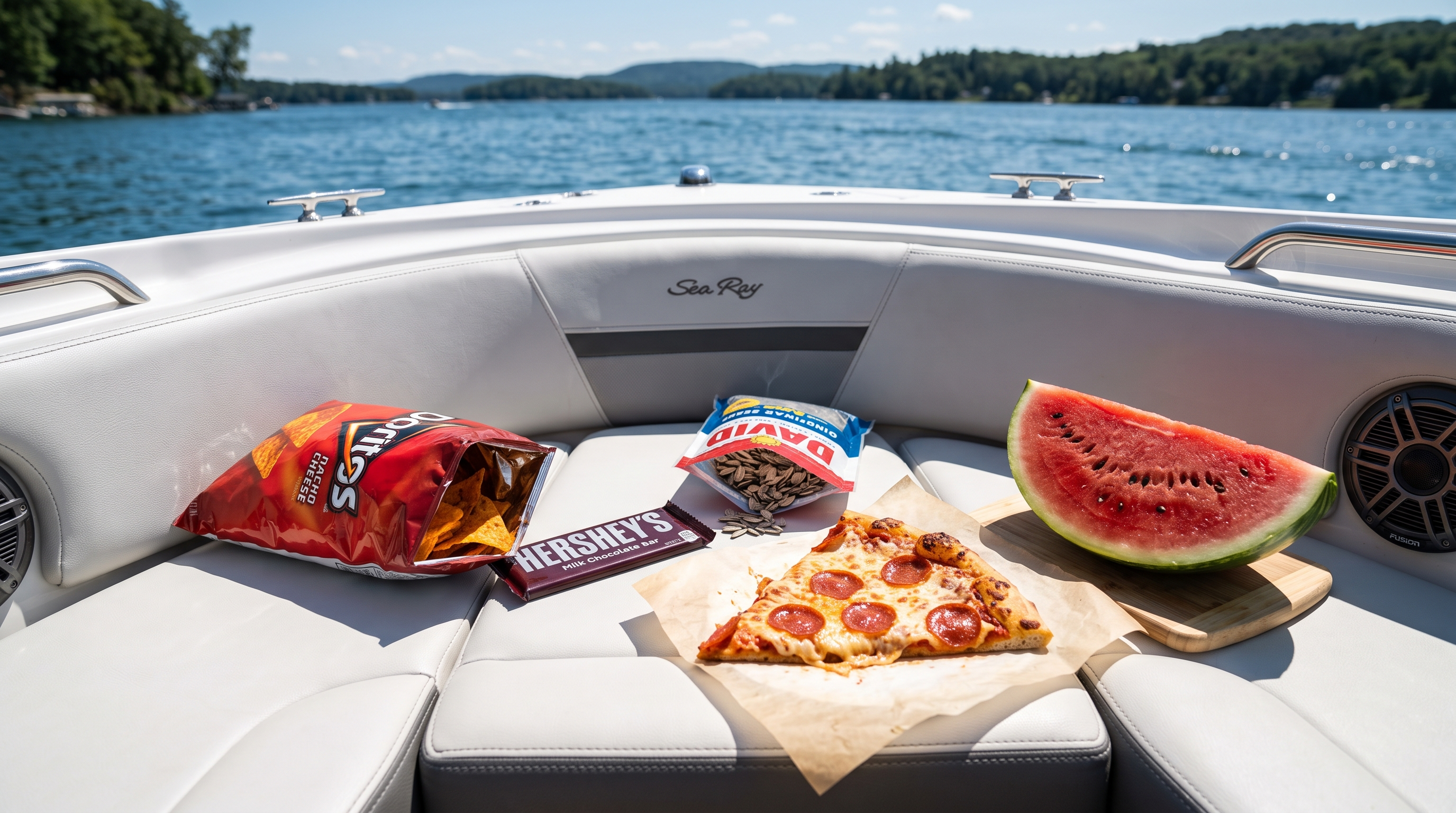
Tomato sauce, buffalo sauce, mustard, brightly colored candy, seasoned chips, sunflower seeds and greasy foods are among the worst foods to spill on a boat. Their combination of oils, food dyes, natural pigments, acids, sugars and fine particles can stain marine vinyl, discolor upholstery, become embedded in EVA foam and non-skid, and leave difficult-to-remove residues on gelcoat and other boat surfaces.
The good news is that many food spills can be removed without aggressive chemicals, if they're addressed quickly.
The bad news? Heat and sunlight can turn a relatively harmless spill into a much more difficult stain.
Marine upholstery presents a particularly challenging environment because boat surfaces routinely become extremely hot in direct sunlight. A splash of buffalo sauce that might wipe easily from a kitchen countertop can behave very differently after sitting on light-colored marine vinyl in the summer sun.
From a marine surface-care perspective, the best strategy is simple:
Remove the spill quickly, start with the least aggressive chemistry capable of removing it, and escalate only when necessary.
Here are 10 snacks and foods boat owners should be particularly careful with.
1. Sunflower Seeds
Can sunflower seeds stain boat seats?
Yes. More specifically, wet and flavored sunflower seed shells can leave surprisingly stubborn stains on marine vinyl and other boat surfaces.
The sunflower seed itself isn't usually the biggest problem.
It's the shells.
Flavored sunflower seeds can contain combinations of salt, oils, seasoning powders, spices and coloring agents. Once someone begins eating them, saliva and moisture are added to that mixture.
Then the wet shells inevitably wind up in cupholders, between cushions, on the deck or directly against marine upholstery.
Leave that mixture sitting on a hot white or cream-colored boat seat and brown, yellow or orange discoloration can result.
There's also a mechanical cleaning problem. Crushed shells and seasoning particles easily work their way into:
-
Marine vinyl grain
-
Upholstery stitching
-
EVA foam
-
Non-skid decking
-
Seat tracks
-
Cupholders
-
Drainage channels
How to clean sunflower seed stains from a boat
Remove the shells first without grinding them into the surface.
For remaining residue or discoloration, begin with a pH-neutral marine spot cleaner and a clean microfiber towel. A soft-bristle detailing brush can help lift contamination from textured vinyl and stitching.
SKWOL® pH Neutral Spot Cleaner is designed for marine vinyl, gelcoat, carpets and fabrics without stripping wax, polish or ceramic protection.
For most fresh sunflower-seed messes, aggressive chemistry shouldn't be necessary.
Boat-owner verdict: Sunflower seeds belong surprisingly high on the list of snacks we'd leave at the dock.
2. Buffalo Wings
Does buffalo sauce stain marine vinyl?
It certainly can.
Buffalo sauce creates one of the more difficult combinations for light-colored marine upholstery because you're dealing with both oil and strongly colored red-orange compounds.
Traditional buffalo sauce generally combines a hot pepper sauce with butter or another source of fat.
That creates an important surface-science problem.
Oil can spread across a surface while carrying colored compounds with it. Instead of having only a superficial red spot, you may end up with oily contamination distributed throughout the microscopic texture of the vinyl.
White, cream and oyster-colored marine upholstery make the discoloration particularly noticeable.
Heat can make the situation considerably worse.
How to remove buffalo sauce from boat seats
Blot the spill immediately rather than aggressively wiping it across the seat.
Begin with a pH-neutral cleaner and microfiber towel. Gentle agitation with a soft detailing brush may be necessary for textured vinyl.
If the remaining contamination is primarily oily and a neutral cleaner cannot completely remove it, a surface-compatible degreaser may eventually be required.
But that's where the cleaning process changes.
Degreasers can remove protective treatments along with the grease you're trying to remove.
After using aggressive degreasing chemistry:
Rinse thoroughly, neutralize, dry, restore protection.
On marine vinyl, follow-up protection is particularly important because the material spends its life exposed to UV radiation, heat and moisture.
Boat-owner verdict: Buffalo wings may be great dock food. They're considerably less attractive sitting on white upholstery.
3. Pizza and Foods With Tomato Sauce
Does tomato sauce stain boat seats?
Tomato sauce can stain light-colored marine vinyl, fabrics, carpet and upholstery, particularly when it remains on the surface in direct sunlight.
Tomato-based sauces combine several things we don't particularly like around marine surfaces:
Pigments + oils + organic acids.
Add cheese, pepperoni or sausage and you've introduced even more fat.
The result is contamination that can be both colored and oily.
Gelcoat will generally be more forgiving when a spill is addressed quickly. Textured vinyl, stitching, woven fabrics and marine carpet can be more challenging.
How to remove tomato sauce from marine vinyl
Carefully lift away the food without spreading the sauce.
Blot excess oil with a clean towel.
Then use a pH-neutral marine cleaner to remove the remaining contamination.
Don't assume the surface is clean simply because the red color has disappeared. Inspect for a remaining oily film.
If stronger degreasing chemistry is required, thoroughly rinse and neutralize the area afterward and restore the appropriate protection.
Boat-owner verdict: A pepperoni slice landing face-down on white marine vinyl is a very effective way to end lunch.
4. Cheetos, Doritos and Cheese-Flavored Snacks
Can Cheetos and Doritos stain boat upholstery?
Yes. And the problem often isn't the chip itself.
It's your fingers.
Many heavily seasoned chips contain combinations of oils, cheese solids, spices and concentrated coloring ingredients.
Those finely divided seasoning particles can become embedded in textured surfaces.
Someone eats a handful of chips and then touches:
-
A white seat bolster
-
The steering wheel
-
Grab handles
-
Cupholders
-
A hatch
-
Upholstery
-
EVA flooring
Now you don't have one stain.
You have ten fingerprints distributed around the boat.
How to remove cheese powder from boat surfaces
If significant dry seasoning is present, remove or vacuum loose material before wetting it.
Adding liquid immediately can turn a dry powder into a paste and work it deeper into surface texture.
Once the loose contamination is removed, clean the area with a pH-neutral marine cleaner and microfiber towel.
Use a soft detailing brush on vinyl grain, stitching or textured surfaces if necessary.
Boat-owner verdict: If the snack turns your fingers orange, assume it can do the same thing to your boat.
5. Ketchup and BBQ Sauce
Can ketchup or barbecue sauce stain marine vinyl?
Both can.
Ketchup shares many of the same concerns as tomato sauce, while barbecue sauce can introduce another major contaminant:
Sugar.
Many barbecue sauces combine tomato concentrates, sugars or syrups, spices, oils and dark coloring compounds.
The obvious red or brown stain usually gets cleaned first.
The sticky residue is what boat owners frequently miss.
Sugar residue can remain inside vinyl grain, stitching and textured surfaces where it attracts dirt and additional contamination.
On a warm, humid boat that spends long periods underneath a cover, leaving organic residue behind is particularly undesirable.
How to clean ketchup and BBQ sauce from boat seats
Remove the bulk contamination immediately.
Then use a damp microfiber towel and pH-neutral cleaner.
Pay particular attention to:
-
Seams
-
Piping
-
Stitching
-
Seat creases
-
Textured vinyl grain
You want to remove the contamination, not simply make the visible color disappear.
Boat-owner verdict: One dropped burger can create an impressive amount of cleanup.
6. Popsicles, Slushies and Brightly Colored Candy
Can food coloring permanently stain boat seats?
Food dyes can cause persistent discoloration on light-colored marine upholstery, stitching, carpet and fabrics.
Bright blue, red, purple and green candies and frozen treats deserve particular attention.
Once sugar, water and concentrated coloring are combined, you have a colored liquid capable of traveling into seams and porous materials.
A melting popsicle is particularly problematic because the contamination doesn't stay where it was dropped.
Liquid can migrate through stitching, underneath cushions and into adjacent materials before anyone notices.
How to remove food dye from marine vinyl
Act quickly.
Blot the liquid rather than spreading it.
Introduce clean water where appropriate to dilute the contamination, then clean with a pH-neutral marine spot cleaner.
Avoid immediately escalating to bleach simply because the stain is brightly colored.
If severe residual discoloration eventually requires an oxidizing cleaner such as hydrogen peroxide or sodium hypochlorite, first confirm that the upholstery manufacturer permits its use.
After using an oxidizer:
Thoroughly rinse, neutralize, allow the surface to dry, restore protection.
Boat-owner verdict: The brighter the popsicle, the farther away we'd like to see it from white marine upholstery.
7. Chocolate
Does chocolate stain boat upholstery?
Chocolate can be particularly troublesome because it combines dark cocoa solids with fats.
Then boats add another variable:
Heat.
A chocolate bar left aboard a boat on a summer afternoon can quickly become a liquid or semi-liquid contaminant.
If someone then sits on it, the chocolate is simultaneously warmed and mechanically pressed into the texture of the upholstery.
Fabric and carpet can be even more challenging because melted fats can penetrate the fibers.
How to remove chocolate from a boat seat
Remove as much bulk material as possible without smearing it.
If the chocolate is extremely soft, allowing it to cool slightly can sometimes make physical removal easier.
Follow with a pH-neutral cleaner.
Persistent oily contamination may require a compatible degreaser.
If you escalate to a stronger degreaser, rinse thoroughly afterward, neutralize the surface and restore its protection.
Boat-owner verdict: Chocolate + July + white marine vinyl is a surface-science experiment we'd rather not conduct.
8. Takis and Heavily Seasoned Spicy Chips
Why are red and spicy chips bad for boat seats?
Takis and similar heavily seasoned snacks combine several undesirable characteristics:
Oil + salt + acidic seasoning + intense pigments + extremely fine powder.
The contamination also transfers exceptionally well from fingers.
Someone doesn't have to spill the bag to create a problem.
Every time they grab a seat bolster, open a compartment or steady themselves against the upholstery, they're transferring some combination of oil and seasoning.
How to clean red chip stains from marine vinyl
Remove dry particulate contamination first.
Then clean with a pH-neutral marine cleaner.
Use a soft detailing brush to work cleaner through textured vinyl without aggressively abrading the material.
Persistent discoloration should be treated methodically rather than immediately reaching for the strongest chemical available.
Boat-owner verdict: Anything that requires licking bright red seasoning off your fingers probably shouldn't be eaten while sitting on white boat seats.
9. Mustard
Why can mustard stain boat seats yellow?
Mustard is one of the most underestimated staining foods on a boat.
Its intense yellow coloration can come partly from turmeric and other naturally occurring pigments, which can produce persistent yellow discoloration.
And this illustrates an important concept in marine surface care:
Cleaning and stain removal aren't always the same thing.
You can successfully remove the mustard itself while still seeing discoloration afterward.
That doesn't necessarily mean the cleaner failed.
The pigment may have migrated into or interacted with the material.
At that point, repeatedly scrubbing harder can accomplish little besides damaging the surface.
How to remove mustard stains from marine vinyl
Remove the mustard immediately.
Begin with pH-neutral chemistry and allow appropriate dwell time without permitting the cleaner to dry.
Gently agitate textured vinyl with a soft-bristle detailing brush.
If yellow discoloration remains after the contamination has been removed, consult the upholstery manufacturer's cleaning recommendations before escalating to oxidizers or aggressive chemistry.
If hydrogen peroxide, sodium hypochlorite, acidic cleaners or highly alkaline cleaners become necessary:
Rinse, neutralize, dry, protect.
Boat-owner verdict: Mustard may be the most underestimated condiment aboard a boat.
10. Fried Chicken, French Fries and Greasy Foods
Can grease stain boat seats and EVA foam?
Yes.
Grease doesn't have to be brightly colored to create problems.
Cooking oils and animal fats can spread across vinyl, darken fabrics, penetrate absorbent materials and become embedded in textured flooring.
Grease can be especially frustrating on EVA foam and textured marine decking, where oils can settle into microscopic surface irregularities.
Oily residues also attract dirt, making subsequent contamination adhere more readily.
How to remove grease from boat surfaces
Blot first.
Don't smear.
Start with a pH-neutral cleaner and appropriate mechanical agitation.
If the amount of grease exceeds what neutral cleaning chemistry can reasonably remove, a compatible degreaser may be necessary.
There is nothing inherently wrong with using stronger chemistry when the contamination legitimately requires it.
The problem is using restorative chemistry as routine maintenance chemistry.
Once the grease is removed, thoroughly rinse the area, neutralize the surface and restore protection where necessary.
Boat-owner verdict: Fresh grease is manageable. Grease that's been sitting on a hot boat all afternoon can become a project.
What Foods Are Most Likely to Stain Boat Seats?
The foods most likely to create difficult stains on marine vinyl and boat upholstery generally contain one or more of the following:
| Contaminant | Common Foods | Why It's a Problem |
|---|---|---|
| Red/orange pigments | Tomato sauce, buffalo sauce, ketchup | Visible discoloration on light upholstery |
| Food dyes | Popsicles, candy, slushies | Concentrated color can migrate into materials |
| Oils and fats | Wings, pizza, chocolate, fried foods | Spread easily and can penetrate textured surfaces |
| Turmeric/natural pigments | Mustard, seasoned foods | Can leave persistent yellow staining |
| Fine colored powders | Cheetos, Doritos, Takis | Become embedded in vinyl grain and stitching |
| Sugar | BBQ sauce, soda, candy | Leaves sticky residue that attracts contamination |
| Salt | Chips, sunflower seeds | Residue can remain in seams and difficult-to-reach areas |
| Acids | Tomato products, hot sauces | Can complicate contamination and cleaning |
The presence of one of these ingredients doesn't guarantee permanent damage.
Time, temperature, surface condition and material type matter enormously.
What Is the Best Cleaner for Food Stains on Boat Seats?
For fresh food spills on marine vinyl, gelcoat, carpet and fabrics, a pH-neutral marine spot cleaner is generally the best place to start.
The objective should always be to use the least aggressive chemistry capable of removing the contamination.
SKWOL® pH Neutral Spot Cleaner was designed specifically for this role. It can be used on marine vinyl, gelcoat, carpet and fabrics and does not rely on degreasers or dyes. It is also designed to clean without stripping wax, polish or ceramic coatings.
That makes pH-neutral chemistry particularly useful aboard a boat because one bottle can address many routine spills without unnecessarily introducing aggressive acids, alkalines or oxidizers.
But pH-neutral does not mean capable of solving every possible contamination problem.
No responsible marine-care manufacturer should claim otherwise.
When Does a Boat Stain Require a Stronger Cleaner?
Some contamination legitimately requires specialized chemistry.
Heavy grease may require a degreaser.
Mineral deposits and certain inorganic stains may require acidic chemistry.
Severe organic discoloration or microbial staining may occasionally require an oxidizer such as hydrogen peroxide or sodium hypochlorite.
These products have legitimate uses.
The distinction is that they're generally better viewed as corrective or restorative chemistry rather than everyday maintenance chemistry.
Aggressive cleaners can affect more than the contamination you're trying to remove.
Depending on the chemical and surface, they may also compromise waxes, sealants, UV protectants, conditioners and other protective treatments.
That's why stronger isn't automatically better.
What Should You Do After Using Bleach, Degreaser, Acid or Peroxide on a Boat?
When aggressive chemistry is necessary, the cleaning process shouldn't end when the stain disappears.
A good general procedure is:
1. Remove the contamination.
Use the specialized chemistry only where appropriate and according to the surface manufacturer's recommendations.
2. Rinse thoroughly.
Remove residual cleaning chemistry from the surface.
3. Neutralize the surface.
Follow aggressive acids, alkalines, degreasers and oxidizers with an appropriate neutralization and cleaning process.
4. Allow the surface to dry.
Don't trap residual moisture beneath protectants.
5. Restore protection.
Reapply the appropriate protection for that particular surface.
For marine vinyl, SKWOL® Vinyl UV / Mold Protectant can be used after the surface has been properly cleaned and dried. It is designed for vinyl, rubber, canvas and closed-cell foam such as EVA and provides UV and mold/mildew protection while leaving a matte, non-greasy finish.
Why Food Stains Get Worse When Left on a Boat
The biggest factor determining whether a food spill becomes a major detailing problem often isn't the food itself.
It's time.
A boat adds several environmental variables that aren't present in your kitchen:
-
Intense sunlight
-
UV exposure
-
High surface temperatures
-
Humidity
-
Moisture
-
Textured materials
-
Long periods beneath a cover
A spill left on a hot seat for five hours can behave very differently from the same spill removed in five minutes.
Heat can increase molecular mobility and reduce the viscosity of oils, allowing contamination to spread more readily across and into microscopic surface textures.
Liquids can migrate through stitching.
Oils can spread.
Water can evaporate while leaving concentrated pigments behind.
Sugars can dry into sticky residues.
Fine powders can become mechanically embedded in surface texture.
That's why speed is often more valuable than cleaning strength.
The Best Boat Stain-Removal Strategy: Start Gentle and Escalate
One of the biggest mistakes boat owners make is immediately reaching for the strongest cleaner available.
Bleach.
Heavy degreaser.
Strong acid.
Highly alkaline cleaner.
Magic eraser.
Sometimes those tools are appropriate.
But every escalation in chemistry or abrasion introduces additional variables.
A better process is:
Remove, blot, pH-neutral clean, inspect, escalate only if necessary, neutralize, protect.
For many ordinary food spills, the process stops at the pH-neutral cleaning stage.
That's exactly where you want it to stop.
The One Cleaning Kit Every Boat Should Have for Food Spills
You don't need ten specialized chemicals sitting beneath the helm.
For routine spills, a simple onboard cleaning kit can handle an enormous percentage of problems:
-
pH-neutral marine spot cleaner
-
Several clean microfiber towels
-
Soft-bristle detailing brush
-
Fresh water
-
Appropriate vinyl or surface protectant
SKWOL® pH Neutral Spot Cleaner is designed for exactly this kind of multi-surface maintenance cleaning and is safe for marine vinyl, gelcoat, carpets and fabrics without stripping wax, polish or ceramic protection.
For marine vinyl, SKWOL® Vinyl UV / Mold Protectant can be used as the protection step after cleaning, particularly when stronger restorative chemistry has been required.
The objective isn't to use more chemicals.
It's to use the minimum amount of chemistry necessary to solve the problem.
Frequently Asked Questions About Food Stains on Boats
What foods should you avoid bringing on a boat?
The most problematic foods include sunflower seeds, buffalo wings, pizza and tomato sauce, mustard, brightly colored candy and popsicles, Cheetos and Doritos, Takis, barbecue sauce, chocolate and greasy fried foods. Foods containing concentrated pigments, oils, dyes and fine seasoning powders pose the greatest staining risk.
What foods stain white boat seats?
Tomato sauce, buffalo sauce, mustard, red or blue food dyes, brightly colored popsicles, seasoned chips and other heavily pigmented foods can leave visible discoloration on white and light-colored marine vinyl.
What is the best way to remove food stains from marine vinyl?
Remove the bulk contamination immediately, blot rather than smear, and begin with a pH-neutral marine cleaner and microfiber towel. Use a soft-bristle detailing brush for textured vinyl. Escalate to specialized chemistry only if the contamination requires it.
Can I use a degreaser on boat seats?
A surface-compatible degreaser may be necessary for severe oily contamination, but it shouldn't automatically be the first choice for routine cleaning. Strong degreasing chemistry can also remove protective treatments. Afterward, thoroughly rinse, neutralize and restore protection.
Can I use bleach on marine vinyl?
Only use sodium hypochlorite when the upholstery manufacturer's care instructions permit it and the contamination actually warrants an oxidizer. Bleach should not automatically be the first response to a food stain. After aggressive chemical cleaning, thoroughly rinse and neutralize the surface and restore its protection.
Can hydrogen peroxide remove stains from boat seats?
Hydrogen peroxide can help with certain types of organic discoloration, but its suitability depends on the upholstery material and stain. It should be considered a specialized treatment rather than a universal boat-seat cleaner.
Will tomato sauce permanently stain marine vinyl?
Not necessarily. Fresh tomato sauce can often be removed successfully when addressed quickly. The likelihood of persistent discoloration increases when strongly pigmented contamination remains on light-colored vinyl for extended periods, particularly in high temperatures.
Why shouldn't I use a Magic Eraser on every boat-seat stain?
Melamine foam cleans partly through microscopic abrasion. While that can make it effective against stubborn marks, repeated or aggressive use can alter the surface finish of certain materials. Chemical cleaning with the least aggressive compatible solution should generally be attempted first.
Why should boat surfaces be protected again after aggressive cleaning?
Degreasers, strong acids, alkaline cleaners and oxidizers may affect existing waxes, sealants, conditioners or protectants along with the contamination. Once aggressive cleaning is complete, the surface should be thoroughly rinsed and returned to an appropriate neutral condition before protection is restored.
The Bottom Line
Boats are supposed to be enjoyed.
Nobody needs to ban pizza from the cockpit.
But there is a remarkably useful rule for deciding which snacks deserve extra caution:
If a food stains your fingers, melts in the sun, drips brightly colored sauce, contains significant grease or comes covered in intensely colored seasoning, assume it can stain your boat too.
And when something inevitably gets spilled, don't wait until you're back at the dock.
Remove the bulk contamination immediately.
Blot instead of smear.
Start with pH-neutral chemistry.
Escalate only when necessary.
And if aggressive chemistry becomes necessary, neutralize and protect the surface afterward.
Because when it comes to marine vinyl, gelcoat, EVA foam, carpet and other boat surfaces, the easiest stain to remove is usually the one that's five minutes old, not the one that's been baking in the sun all afternoon.
worst snacks to bring on a boat · how to remove food stains from boat seats · marine vinyl stain removal · how to clean boat seats · tomato sauce stain marine vinyl · buffalo sauce boat seat stain · sunflower seeds on boat · food dye on boat seats · best cleaner for boat upholstery · pH neutral boat cleaner
What are the worst foods to bring on a boat? · What foods stain marine vinyl? · What snacks stain boat seats? · How do you remove food stains from boat upholstery? · Can tomato sauce stain boat seats? · Does buffalo sauce stain marine vinyl? · Can sunflower seeds stain boat seats? · What cleaner should I use on marine vinyl?
Share:
Your Boat Needs Sunscreen. Here Is Which Kind.